

SKU
RXSOL-19-1101-210
Title
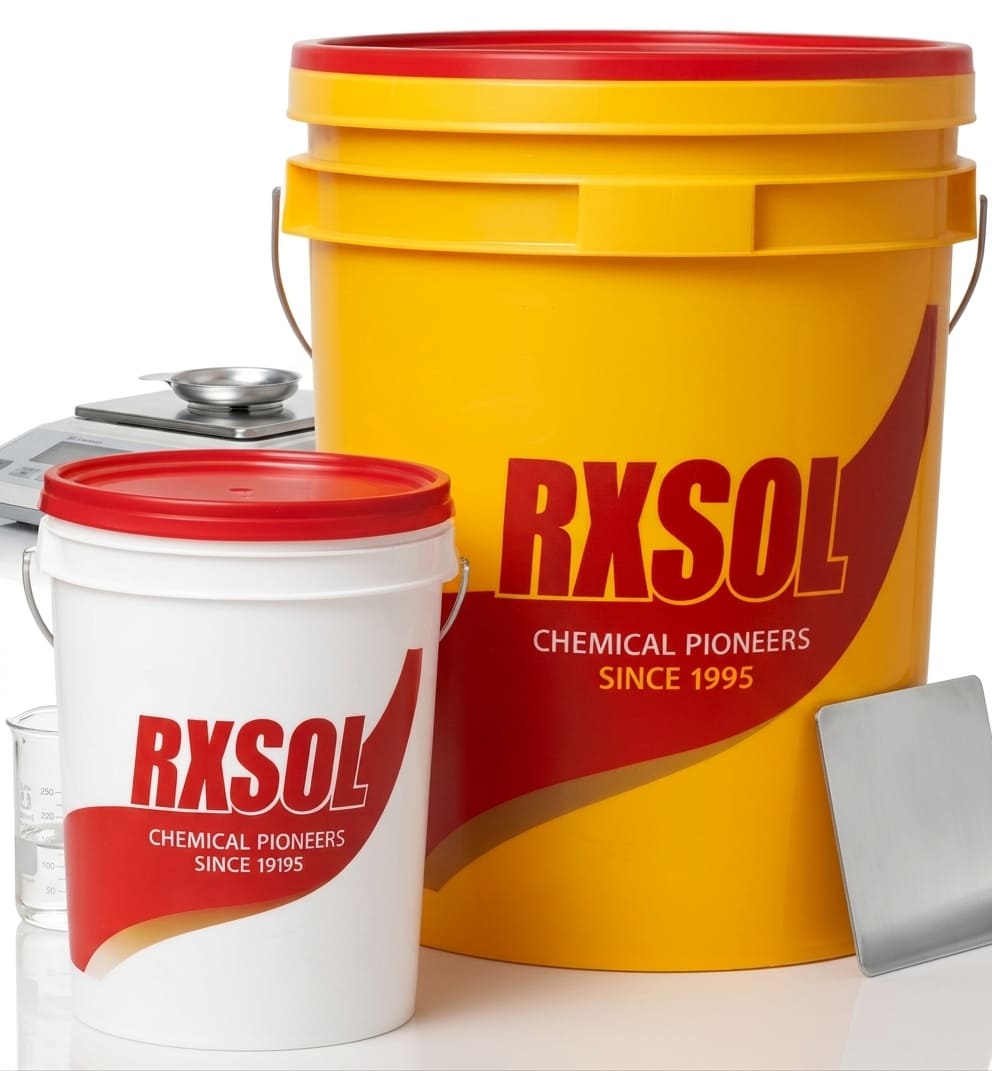
Hydrochloric Acid 250 Kg
Title
Hydrochloric Acid 250 Kg
Hydrochloric acid is the aqueous solution of hydrogen chloride gas (HCl). It is a strong acid, and the major component of gastric acid. It is also widely used in industry. Hydrochloric acid must be handled with appropriate safety precautions because it is a highly corrosive solution.
Hydrogen chloride (HCl) is a monoprotic acid, which means it can dissociate (i.e., ionize) only once to give up one H+ion (a single proton). In aqueous Muriatic acid, the H+joins a water molecule to form a hydronium ion, H3O+:
HCl + H2O H3O++ Cl-
The other ion formed is Cl-, the chloride ion. Hydrochloric acid can therefore be used to prepare salts called chlorides, such as sodium chloride. Hydrochloric acid is a strong acid, since it is fully dissociated in water.
Monoprotic acids have one acid dissociation constant, Ka, which indicates the level of dissociation in water. For a strong acid like HCl, the Ka is large. Theoretical attempts to assign a Ka to HCl have been made.[3]When chloride salts such as NaCl are added to aqueous HCl they have practically no effect on pH, indicating that Cl-is an exceedingly weak conjugate base and that HCl is fully dissociated in aqueous solution. For intermediate to strong solutions of hydrochloric acid, the assumption that H+molarity (a unit of concentration) equals HCl molarity is excellent, agreeing to four significant digits.
Of the seven common strong acids in chemistry, all of them inorganic, Hydrochloric acid is the monoprotic acid least likely to undergo an interfering oxidation-reduction reaction. It is one of the least hazardous strong acids to handle; despite its acidity, it produces the less reactive and non-toxic chloride ion. Intermediate strength Hydrochloric acid solutions are quite stable, maintaining their concentrations over time. These attributes, plus the fact that it is available as a pure reagent, mean that Hydrochloric acid makes an excellent acidifying reagent and acid titrant (for determining the amount of an unknown quantity of base in titration). Strong acid titrants are useful because they give more distinct endpoints in a titration, making the titration more precise.
Category
RO Chemicals-33
Product Remarks
Remarks
<p style="text-align: justify">
<span style="color: #0000cd"><strong>Safety</strong></span></p>
<p style="text-align: justify">
<span style="color: #0000cd"><span face="">Hydrochloric</span></span><span style="color: #0000cd"> acid in high concentrations forms acidic mists. Both the mist and the solution have a corrosive effect on human tissue, with the potential to damage respiratory organs, eyes, skin, and intestines. Upon mixing Muriatic acid with common oxidizing chemicals, such as bleach (NaClO) or permanganate (KMnO<sub>4</sub>), the toxic gas chlorine is produced. To minimize the risks while working with hydrochloric acid, appropriate precautions should be taken, including wearing rubber or PVC gloves, protective eye goggles, and chemical-resistant clothing.</span></p>
Field Note
Note
<br />
Technical Specifications
<p>
<br />
</p>
<table border="0" cellpadding="0" style="width: 98%" width="98%">
<tbody>
<tr>
<td>
<span style="color: #0000cd"> </span></td>
<td>
<p>
<span style="color: #0000cd"> </span></p>
</td>
</tr>
<tr>
<td colspan="2">
<p align="center">
<span style="color: #0000cd"><strong>Properties</strong></span></p>
</td>
</tr>
<tr>
<td>
<p>
<span style="color: #0000cd">Molecular formula</span></p>
</td>
<td>
<p>
<span style="color: #0000cd">HCl in water (H<sub>2</sub>O)</span></p>
</td>
</tr>
<tr>
<td>
<p>
<span style="color: #0000cd">Molar mass</span></p>
</td>
<td>
<p>
<span style="color: #0000cd">36.46 g/mol (HCl)</span></p>
</td>
</tr>
<tr>
<td>
<p>
<span style="color: #0000cd">Appearance</span></p>
</td>
<td>
<p>
<span style="color: #0000cd">Clear colorless to light-yellow liquid</span></p>
</td>
</tr>
<tr>
<td>
<p>
<span style="color: #0000cd">Melting point</span></p>
</td>
<td>
<p>
<span style="color: #0000cd">−26°C (247 K) 38% solution</span></p>
</td>
</tr>
<tr>
<td>
<p>
<span style="color: #0000cd">Boiling point</span></p>
</td>
<td>
<p>
<span style="color: #0000cd">110 °C (383 K), 20.2% solution;<br />
48°C (321 K), 38% solution.</span></p>
</td>
</tr>
<tr>
<td>
<p>
<span style="color: #0000cd">Solubility in water</span></p>
</td>
<td>
<p>
<span style="color: #0000cd">Miscible</span></p>
</td>
</tr>
<tr>
<td>
<p>
<span style="color: #0000cd">Acidity (pKa)</span></p>
</td>
<td>
<p>
<span style="color: #0000cd">−8.0</span></p>
</td>
</tr>
<tr>
<td>
<p>
<span style="color: #0000cd">Viscosity</span></p>
</td>
<td>
<p>
<span style="color: #0000cd">1.9 mPa s at 25° C,<br />
31.5% solution</span></p>
</td>
</tr>
<tr>
<td>
<p>
<span style="color: #0000cd">Flash point</span></p>
</td>
<td>
<p>
<span style="color: #0000cd">Non-flammable</span></p>
</td>
</tr>
</tbody>
</table>
Application
<p style="text-align: justify">
<span style="color: #0000cd"><span face="">Hydrochloric acid is a strong inorganic acid that is used in many industrial processes. The application often determines the required product quality.</span></span></p>
<p style="text-align: justify">
<span style="color: #0000cd"><strong><span face="">Regeneration of ion exchangers</span></strong></span></p>
<p style="text-align: justify">
<span style="color: #0000cd"><span face="">An important application of high-quality hydrochloric acid is the regeneration of ion exchange resins. Cation exchange is widely used to remove ions such as Na+ and Ca<sup>2+</sup> from aqueous solutions, producing demineralized water.</span></span></p>
<p style="text-align: justify">
<span style="color: #0000cd"><span face="">Na<sup>+ </sup>is replaced by H<sub>3</sub>O<sup>+</sup><br />
Ca<sup>2+</sup> is replaced by 2 H<sub>3</sub>O<sup>+</sup> </span></span></p>
<p style="text-align: justify">
<span style="color: #0000cd"><span face="">Ion exchangers and demineralized water are used in all chemical industries, drinking water production, and many food industries.</span></span></p>
<p style="text-align: justify">
<span style="color: #0000cd"><strong><span face="">pH Control and neutralization</span></strong></span></p>
<p style="text-align: justify">
<span style="color: #0000cd"><span face="">A very common application of </span></span><span style="color: #0000cd"><span face="">Hydrochloric</span></span><span style="color: #0000cd"><span face=""> acid is to regulate the basicity (pH) of solutions.</span></span></p>
<p style="text-align: justify">
<span style="color: #0000cd"><span face="">OH<sup>-</sup> + HCl H<sub>2</sub>O + Cl<sup>-</sup></span></span></p>
<p style="text-align: justify">
<span style="color: #0000cd"><span face="">In industry demanding purity (food, pharmaceutical, drinking water), high-quality Muriatic acid is used to control the pH of process water streams. In less-demanding industry, technical-quality hydrochloric acid suffices for neutralizing waste streams and swimming pool treatment.</span></span></p>
<p style="text-align: justify">
<span style="color: #0000cd"><strong><span face="">Pickling of steel</span></strong></span></p>
<p style="text-align: justify">
<span style="color: #0000cd"><span face="">Pickling is an essential step in metal surface treatment, to remove rust or iron oxide scale from iron or steel before subsequent processing, such as extrusion, rolling, galvanizing, and other techniques. Technical-quality HCl at typically 18% concentration is the most commonly-used pickling agent for the pickling of carbon steel grades.</span></span></p>
<p style="text-align: justify">
<span style="color: #0000cd"><span face="">Fe<sub>2</sub>O<sub>3</sub> + Fe + 6 HCl 3 FeCl<sub>2</sub> + 3 H<sub>2</sub>O </span></span></p>
<p style="text-align: justify">
<span style="color: #0000cd"><span face="">The spent acid has long been re-used as ferrous chloride solutions, but high heavy-metal levels in the pickling liquor has decreased this practice.</span></span></p>
<p style="text-align: justify">
<span style="color: #0000cd"><span face="">In recent years, the steel pickling industry has, however, developed hydrochloric acid regeneration processes, such as the spray roaster or the fluidized bed HCl regeneration process, which allow the recovery of HCl from spent pickling liquor. The most common regeneration process is the pyrohydrolysis process, applying the following formula:</span></span></p>
<p style="text-align: justify">
<span style="color: #0000cd"><span face="">4 FeCl<sub>2</sub> + 4 H<sub>2</sub>O + O<sub>2</sub> 8 HCl+ 2 Fe<sub>2</sub>O<sub>3</sub> </span></span></p>
<p style="text-align: justify">
<span style="color: #0000cd"><span face="">By recuperation of the spent acid, a closed acid loop is established. The ferric oxide by product of the regeneration process is a valuable by-product, used in a variety of secondary industries.</span></span></p>
<p style="text-align: justify">
<span style="color: #0000cd"><span face="">Hydrochloric</span></span><span style="color: #0000cd"><span face=""> Acid is not a common pickling agent for stainless steel grades.</span></span></p>
<p style="text-align: justify">
<span style="color: #0000cd"><span face="">Production of inorganic compounds</span></span></p>
<p style="text-align: justify">
<span style="color: #0000cd"><span face="">Numerous products can be produced with hydrochloric acid in normal acid-base reactions, resulting in inorganic compounds. These include water treatment chemicals such as iron(III) chloride and polyaluminium chloride (PAC).</span></span></p>
<p style="text-align: justify">
<span style="color: #0000cd"><span face="">Fe<sub>2</sub>O<sub>3</sub> + 6 HCl 2 FeCl<sub>3</sub> + 3 H<sub>2</sub>O </span></span></p>
<p style="text-align: justify">
<span style="color: #0000cd"><span face="">Both iron(III) chloride and PAC are used as flocculation and coagulation agents in wastewater treatment, drinking water production, and paper production.</span></span></p>
<p style="text-align: justify">
<span style="color: #0000cd"><span face="">Other inorganic compounds produced with hydrochloric acid include road application salt calcium chloride, nickel(II) chloride for electroplating, and zinc chloride for the galvanizing industry and battery production.</span></span></p>
<p style="text-align: justify">
<span style="color: #0000cd"><strong><span face="">Production of organic compounds</span></strong></span></p>
<p style="text-align: justify">
<span style="color: #0000cd"><span face="">The largest </span></span><span style="color: #0000cd"><span face="">Hydrochloric</span></span><span style="color: #0000cd"><span face=""> acid consumption is in the production of organic compounds such as vinyl chloride for PVC, and MDI and TDI for polyurethane. This is often captive use, consuming locally-produced Muriatic acid that never actually reaches the open market. Other organic compounds produced with Muriatic acid include bisphenol A for polycarbonate, activated carbon, and ascorbic acid, as well as numerous pharmaceutical products.</span></span></p>
<p style="text-align: justify">
<strong><span style="color: #0000cd"><span face="">Domestic and Industrial as cleaning Compound :</span></span></strong></p>
<p style="text-align: justify">
<span style="color: #0000cd"><span face="">Hydrochloric</span></span><span style="color: #0000cd"><span face=""> acid is a fundamental chemical, and as such it is used for a large number of small-scale applications, such as leather processing, household cleaning, and building construction. In addition, a way of stimulating oil production is by injecting </span></span><span style="color: #0000cd"><span face="">Hydrochloric</span></span><span style="color: #0000cd"><span face=""> acid into the rock formation of an oil well, dissolving a portion of the rock, and creating a large-pore structure. Oil-well acidizing is a common process in the North Sea oil production industry.</span></span></p>
<p style="text-align: justify">
<span style="color: #0000cd"><span face="">Many chemical reactions involving </span></span><span style="color: #0000cd"><span face="">Hydrochloric</span></span><span style="color: #0000cd"><span face=""> acid are applied in the production of food, food ingredients, and food additives. Typical products include aspartame, fructose, citric acid, lysine, hydrolyzed (vegetable) protein as food enhancer, and in gelatin production. Food-grade (extra-pure) Muriatic acid can be applied when needed for the final product.</span></span></p>
Industrial Area
<div id="cke_pastebin">
Manufacturer and supplier in India, UAE Middle East, Muscat Oman, Nairobi Kenya Africa, Canaya.<br />
SLES</div>
<div id="cke_pastebin">
HCL</div>
<div id="cke_pastebin">
Sulphuric Acid</div>
<div id="cke_pastebin">
Nitric Acid</div>
<div id="cke_pastebin">
Acetic Acid</div>
<div id="cke_pastebin">
Ferrous Sulphate</div>
<div id="cke_pastebin">
Sodium Sulphate Anhydrous</div>
<div id="cke_pastebin">
PAC</div>
<div id="cke_pastebin">
Also Find attached the TDS for HCL , SLES and Sulphuric Acid</div>
Dose
<p>
<span style="color: #0000cd">Depends on use and application.</span></p>
Locations
<p style="text-align: justify;">
Hydrochloric Acid HCl exporter and supplier in India - Mumbai - Gujrat - Kolkata - Chennai- Andhrapradesh</p>